
Minimalist Lifestyle Tips – A 30-Day Starter Plan for Beginners, Day by Day

Quick answer
These minimalist lifestyle tips work as a 30-day plan you can follow day by day, not as another list of tips to read and forget. Spend 30 minutes on prep, then do one small action a day for 10 to 20 minutes. Start with the easiest wins and save the hardest things – photos, sentimental items, the garage – for last. By day 30 you will have cleared every room, your phone, and your spending habits, and you will have a simple plan to keep it that way.
If you want the tips themselves, our companion post Minimalism Lifestyle Tips (2026) has 25 of them, plus the research behind minimalism and answers to 20 common questions. This post is the plan: what to do, in what order, on which day.
Before day 1: prep in 30 minutes
These minimalist lifestyle tips begin with 30 minutes of prep, not with a bin bag. Do not start decluttering on day 1. Spend 30 minutes getting ready first. Every challenge page in this field starts at day 1 with no setup, and that is why people quit in week 1: they have nowhere to put things and no plan for where the bags go.
Get three boxes and a bag
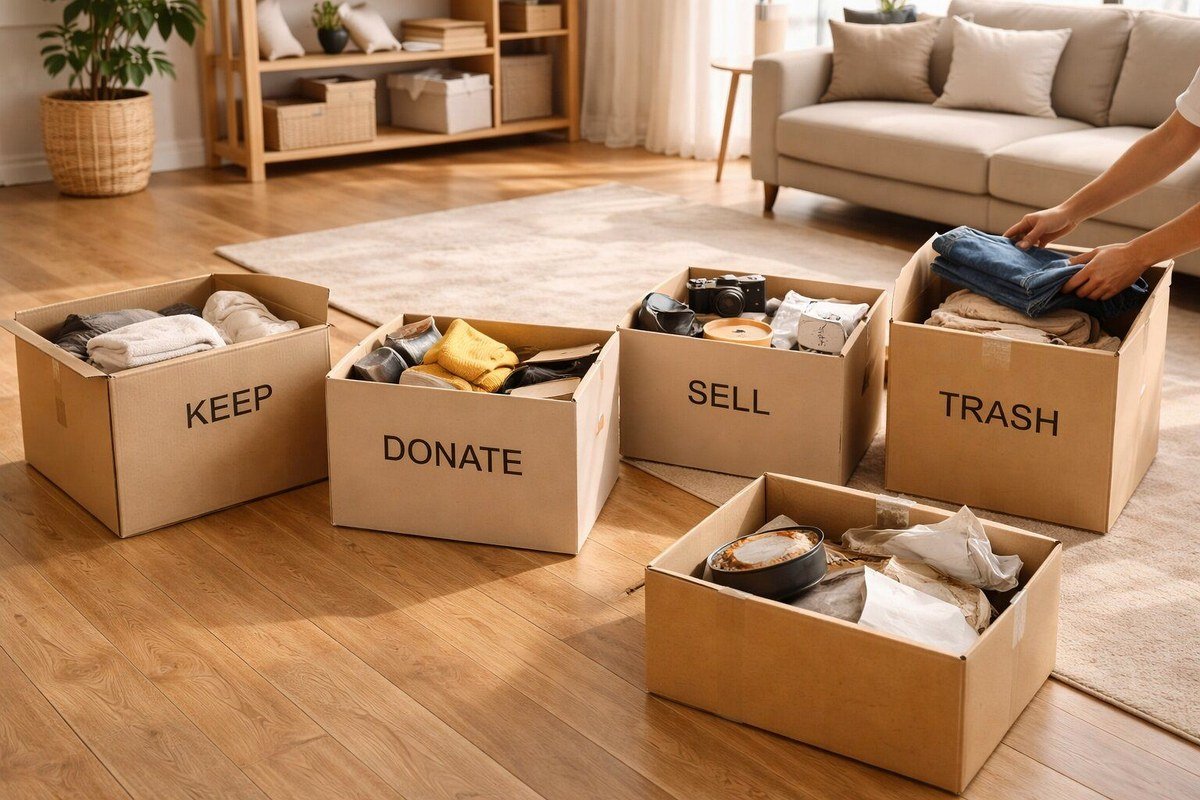
Label three boxes: keep, donate, sell. Add one bag for recycling and rubbish. That is your whole system for the month. When a box fills up, move it out of the room the same day so it does not become a new pile.
Pick your donation drop-off now
Find the nearest charity shop or donation point and note its opening hours. Put a weekly drop-off in your calendar for the next four weeks. Bags that sit in the hallway for a month are not decluttered, they are relocated.
Take before photos of the three worst spots
Photograph the three places that bother you most: the junk drawer, the closet floor, the kitchen counter. You will take the same three photos on day 29. The difference is your proof that the month worked.
Tell the people in your house what you are doing
Say what you are doing, when, and one important promise: you will not touch their things. Joshua Becker, who writes about minimalism at Becoming Minimalist, puts it plainly: never start by decluttering your partner’s stuff or your kids’ toys. Do your own stuff first and let them watch the result.
What to declutter first – and what NOT to declutter first
The most common beginner mistake is starting in the wrong place. Becker says the most effective strategy is to start easy and work up to harder areas. Start with visible surfaces in the rooms you live in most, the bedroom and the living room, where you will see the change every day. Then move to the kitchen and bathroom, then clothes, then paper and digital. Save photos, sentimental items and the garage for last.
10 things NOT to declutter first
Becker lists ten things people are tempted to start with that almost always end in frustration. They appear in no particular order in his list, and the reason is the same for all of them: they are slow, emotional, or invisible, so hours of work produce no visible change.
- Photos. Boxes of old family photos take hours, and every photo brings back a memory. Save this for later, and keep only the best.
- Sentimental items. Wait until you have felt the benefits of owning less. The decisions get easier after a few weeks of wins.
- Paper. One small pile of paper can eat a whole afternoon and change nothing visible in your home. Remove larger things first.
- The garage. Big cluttered spaces take a lot of time, and most people drive in and out without spending time there. Start where you actually live.
- Kids’ toys. It is unfair to start your minimalism journey by forcing your kids to give up their things. Go first, and let them see you do it.
- Your partner’s stuff. Never remove a partner’s things without including them. Do your work, set the example, and let them come to it.
- Drawers. Hidden clutter like drawers and cabinets is invisible, so clearing it feels like nothing changed. Start with visible areas first.
- Your collections. Collections need real questions first: do I have too many, will I keep collecting, is there a better way to store them? Your answers change as you go.
- Digital clutter. Deleting emails is real work, but physical clutter carries more weight and burden. Do the physical stuff first.
- Books. If you love books, this is an emotional task, not a quick one. Hold off until the easy wins are behind you.
This plan follows that order on purpose. Books wait until day 12, digital waits until week 4, and sentimental items get one careful box on day 28, not a full sort. Photos and the garage are not in the 30 days at all: they are month-two projects, once you know the method works for you.
Minimalist lifestyle tips: the 30-day calendar, day by day
Here is the whole plan in one table. Each day is one action, 10 to 20 minutes, free or low cost. Print it, copy it, or tick it off on your phone. If you miss a day, do it the next day. Do not restart from day 1.
| Day | Action | Time | Done |
|---|---|---|---|
| 1 | Write down why you want this, and take your three before photos | 15 min | ☐ |
| 2 | Clear one visible surface, a table or a counter, completely | 10 min | ☐ |
| 3 | Clear the junk drawer, one drawer only | 15 min | ☐ |
| 4 | Empty your wallet or bag and remove everything you do not use | 10 min | ☐ |
| 5 | Set up your donation box in a fixed spot and put five items in it | 10 min | ☐ |
| 6 | Turn off non-essential notifications on your phone | 10 min | ☐ |
| 7 | Delete photos from your camera roll, today only | 10 min | ☐ |
| 8 | Closet sweep, 15 minutes, one section only | 15 min | ☐ |
| 9 | Shoes: keep the pairs you wear, box the rest for donation | 15 min | ☐ |
| 10 | Accessories: belts, bags, scarves, jewellery you never wear | 15 min | ☐ |
| 11 | Bathroom drawer and expired toiletries and makeup | 15 min | ☐ |
| 12 | Books: keep the ones you will read again, box the rest | 20 min | ☐ |
| 13 | Duplicates hunt: find ten duplicates and keep only the best one | 15 min | ☐ |
| 14 | One load of laundry start to finish, then a five-minute nightly reset | 20 min | ☐ |
| 15 | Clear the kitchen counters, everything off, only daily items back | 15 min | ☐ |
| 16 | Kitchen cabinets and single-use gadgets you never use | 20 min | ☐ |
| 17 | Fridge and freezer: expired food out, one shelf wiped | 15 min | ☐ |
| 18 | Pantry: expired food out, group what is left by type | 15 min | ☐ |
| 19 | Bathroom: one shelf or cabinet, expired and duplicate products out | 15 min | ☐ |
| 20 | Declutter your car: glove box, boot, and under the seats | 15 min | ☐ |
| 21 | Clear one flat surface and write your go-to meals list for the week | 15 min | ☐ |
| 22 | Delete unused apps from your phone | 10 min | ☐ |
| 23 | Unsubscribe from marketing emails for ten minutes | 10 min | ☐ |
| 24 | Audit your subscriptions and cancel one you do not use | 15 min | ☐ |
| 25 | No-spend day: buy nothing except food and essentials | All day | ☐ |
| 26 | Start a 72-hour list: any non-essential purchase waits 72 hours | 10 min | ☐ |
| 27 | Say no to one commitment and block white space on your calendar | 10 min | ☐ |
| 28 | Pack one Box of Life per person: the sentimental items that matter most | 20 min | ☐ |
| 29 | Measure your progress: bags out, money saved, before and after photos | 15 min | ☐ |
| 30 | Write your maintenance plan and pick the next 30 days | 20 min | ☐ |
Week 1 (Days 1-7): easy wins and setup
Week 1 is about proof, not progress. Every task is small and visible: a surface, a drawer, a bag. By day 7 you will have five visible wins and a donation box that is already filling up. If you feel the urge to do more, resist it. The plan works because it is small.
Week 2 (Days 8-14): clothes and personal
Week 2 is the closet and the bathroom, the two places where most people own far more than they use. The duplicates hunt on day 13 is the easiest win of the whole month: most homes have three phone chargers, two identical black tops, and a drawer of pens that do not work. Day 14 ends the week with a nightly reset, five minutes to put things back where they belong, which is the habit that keeps the rest of the month from unravelling.
Week 3 (Days 15-21): home rooms
Week 3 is the kitchen, the bathroom and the car. These are the most lived-in spaces, so the change is the most noticeable. Day 21 adds a go-to meals list, because a simpler kitchen only stays simple if dinner is easy to plan. If you share a home, this is the week your family will start to notice the difference, which makes the partner conversation in the next section easier.
Week 4 (Days 22-30): digital, money, mind, and maintenance
Week 4 moves from things to habits: your phone, your subscriptions, your spending, and your calendar. Day 25, the no-spend day, is the hardest single day for most people, which is why it comes after three weeks of wins. Day 28 handles sentimental items gently, one box per person, no decisions forced. Day 29 measures everything, and day 30 turns the challenge into a routine.
If you want a harder challenge after this one, the 30-Day Minimalism Game, created by The Minimalists in 2011, asks you to remove one item on day 1, two on day 2, and so on, 465 items in total over 30 days. Our companion post Minimalism Lifestyle Tips (2026) explains the game and its rules in full.

9 beginner mistakes (and the fix for each)
No top tips page has a dedicated mistakes section, and the companion post only lists four short ones. These nine come from The Simplicity Habit, Bairon’s Fashion, and SpainExchange, and each one has a fix built into this plan.
1. Decluttering too quickly
The purge pitfall: clearing everything in one weekend, then buying half of it back. The fix is the plan itself: 10 to 20 minutes a day, no more. Slow is what makes it last.
2. Starting in the hardest place
Photos, the garage, your partner’s things. The fix is Becker’s order above: easiest first, hardest last. If a task makes you emotional on day 1, it is the wrong task for day 1.
3. Focusing only on physical clutter
A tidy house with 200 unread emails and 14 subscriptions is not a simpler life. The fix is week 4: digital, money, and time get their own days, not an afterthought.
4. Being guided by trends instead of values
Buying beige storage boxes because minimalism looks a certain way on social media. The fix is day 1: write your own why. If your why is “less cleaning time”, your plan will look different from someone whose why is “save money”, and both are right.
5. Throwing things away instead of donating or recycling
The fastest way to declutter is a bin bag, and the most wasteful. The fix is the three-box system from prep day: keep, donate, sell, plus a bag for recycling. Good things go to people who need them.
6. Mistaking minimalism for deprivation
Minimalism is not owning nothing. It is keeping what you use or love and letting go of the rest. If you use it every week, it stays. The fix is the one question on every day of this plan: do I use this, or do I love it?
7. Buying “minimalist” products to start
New storage boxes, new labels, a new app. The fix: buy nothing for the first 30 days. The plan needs three boxes you already own and a phone camera, nothing else.
8. Expecting perfection
Miss a day and the whole month feels ruined, so people quit. The fix is written into the plan: miss a day, do it the next day, do not restart from day 1. A 30-day plan with 28 days done still works.
9. Ignoring the inflow of new items
Decluttering without stopping new things coming in is like bailing water with the tap running. The fix is day 26 and day 30: the 72-hour rule for purchases and one-in-one-out as a permanent habit. Our companion post explains both rules, plus the 30/30 rule, in detail.

When your partner or family is not on board
Two full articles exist on this subject, from Modern Minimalism and Balance Through Simplicity, but no tips or challenge page includes it. That is strange, because it is the reason most people stop. Here is the agreed advice, in short.
Start with your own stuff only
Declutter your own room and closet first. Never declutter a partner’s things or a child’s things without permission. When your kids see you removing your own possessions first, they are more prepared for when you eventually get to theirs.
Talk about your why, not their clutter
Say what minimalism gives you: less cleaning, more time, less money spent. Do not criticise their clutter or call their things junk. The conversation works when it is about your life, not their stuff.
Agree clutter-free zones and clutter-safe zones
Shared spaces, the living room and the kitchen, are clutter-free zones. Their own spaces, a desk, a shelf, a room, are clutter-safe zones where their things are theirs. This one agreement ends most arguments about minimalism in a shared home.
Make it rewarding, and accept they may never join
Make the first week fun: a donation trip together, a meal with the money saved, a movie night in the newly cleared living room. And accept that a partner may never become a minimalist. That is fine. Your stuff is yours to simplify, and theirs is theirs.

How to measure your progress
No top challenge page tells you how to track the month, so these minimalist lifestyle tips include a tracker. Without one, day 30 feels like nothing changed. Use these three measures.
Count bags out and items out
One bag out per week is a visible win. Write it down: week 1, two bags; week 2, three bags. Count items on the duplicates day and the closet day. A number makes the work real.
Count the money: not spent and earned
Keep a simple savings tracker with three lines. First, money not spent: write down every purchase you skipped because of the 72-hour list, with its price. Second, money earned: total from everything you sold. Third, subscriptions cancelled: monthly cost times 12. A 2025 survey by Capital One Shopping put average US impulse spending at about $254 a month, so the habit is common, not a personal failure, and the tracker shows exactly how much of it you kept.
Before and after photos
Take the same three photos on day 29 that you took on day 1, from the same spot, in the same light. Put them side by side. This is the single most convincing piece of evidence that the month worked, and it is the photo you will show friends who ask what you did.

Selling and donating: the practical steps
Almost Zero Waste lists resale sites per category, but no page explains the practical steps. Here they are.
How to price things
A rule of thumb: start at about a third of the new price for items in good condition. Drop the price after a week if it has not sold. Bundle small items together, five books for one price sells faster than five separate listings. Price is a guess, not a fact, so do not spend an hour researching one item.
Where to sell
Local buy-and-sell groups are fastest for furniture and large items, because there is no postage. eBay works for branded items and electronics. Poshmark works for clothes and beauty products. List five items at a time, not fifty: listing is work, and a pile of unsold listings is just digital clutter.
Which charities take what
Clothes and household goods go to charity shops. Unopened food goes to food banks. Old towels and blankets go to animal shelters, which always need them. Check the charity’s website before you drive there, because not every shop takes every item.
What to do with items that do not sell
Give every unsold item a deadline: one week on the selling site, then it is donated, recycled, or disposed of. Do not bring it back inside. The deadline is what stops the selling pile from becoming a permanent feature of the spare room.
After day 30: the maintenance plan
A 30-day challenge that ends on day 30 is a clean-out, not a lifestyle. These minimalist lifestyle tips only become a lifestyle when the maintenance plan is part of them, and no challenge page gives a free one. Here is yours.
Monthly 30-minute reset
Once a month, spend 30 minutes on three things: one drawer, one shelf, one surface. That is enough to stop clutter from building up again, and it is short enough that you will actually do it.
Quarterly audit
Every three months, audit four things: apps on your phone, subscriptions, clothes, and papers. Cancel, delete, donate, file. The quarterly audit catches the slow creep that the monthly reset misses.
One in, one out, for good
From day 30 onward, one thing in means one thing out. A new shirt means an old shirt goes to the donation box. This single rule is the difference between a tidy month and a tidy life.
Yearly review
Once a year, look at your values list from day 1 and ask three questions: what worked, what did not, and what do I want next year? Then pick the next 30 days. Minimalism is a direction, not a finish line.
FAQs
How do I declutter when my spouse does not want to?
Start with your own stuff only, and never remove a partner’s things without permission. Talk about what minimalism gives you, not about their clutter. Agree clutter-free zones for shared spaces and clutter-safe zones for their own spaces. If they never join in, that is fine: your stuff is yours to simplify.
What should I NOT declutter first?
Photos, sentimental items, paper, the garage, kids’ toys, your partner’s stuff, drawers, your collections, digital clutter, and books. These are slow, emotional, or invisible, so hours of work produce no visible change. Start with visible surfaces in the rooms you live in most, and save the hard categories for later. This plan follows that order: books wait until day 12, digital until week 4, and sentimental items get one careful box on day 28.
What is the 30/30 rule for minimalists?
The standard 30/30 rule from The Minimalists is simple: for any purchase over $30, wait 30 hours before buying. Put it on a list and revisit it after the wait. Most of the time the urge is gone. A variant you may see online, wait 30 days for items over $100, is not the standard rule.
What is the 10-10-10 rule for decluttering?
The 10-10-10 rule is a blog rule, not a named minimalist method: spend 10 minutes, in 10 spaces, removing 10 items. It works as a quick starter session when you only have ten minutes, and it fits this plan’s day 2 or day 3. Do not confuse it with a research-backed method: it is a practical shortcut, not a study.
What is the 3-3-3 rule in minimalism?
The 3-3-3 rule is shorthand for Project 333: 33 items of clothing for 3 months. You pick 33 items, including clothes, shoes, jewellery and accessories, and wear only those for three months. Our companion post Minimalism Lifestyle Tips (2026) explains Project 333 and the capsule wardrobe in full.
How long does it take to become a minimalist?
Thirty days is enough to start, and to build the habit of a daily small action. There is no fixed number of days after which you are done, because minimalism is a direction, not a finish line. What changes after 30 days is that the maintenance plan, the monthly reset and one-in-one-out, keeps the result without another big effort.
Where is the best place to sell used clothes and household items?
Local buy-and-sell groups are fastest for furniture and large items. eBay works for branded items and electronics. Poshmark works for clothes and beauty products. List five items at a time, and give every unsold item a one-week deadline, then donate it. Clothes and household goods that do not sell go to charity shops, unopened food to food banks, and old towels to animal shelters.
Sources
- Joshua Becker, 10 Things NOT to Declutter First, Becoming Minimalist: https://www.becomingminimalist.com/10-things-not-to-declutter-first/
- Modern Minimalism, 30-Day Minimalism Challenge: https://modernminimalism.com/30-day-minimalism-challenge/
- Almost Zero Waste, Becoming A Minimalist: 30-Day Challenge: https://www.almostzerowaste.com/become-a-minimalist/
- The Plain Simple Life, How To Become A Minimalist In 30 Days: https://theplainsimplelife.com/how-to-become-a-minimalist-in-30-days/
- Modern Minimalism, How to Be Minimalist When Your Partner Isn’t: https://modernminimalism.com/how-to-be-minimalist-when-your-partner-isnt/
- Balance Through Simplicity, 18 Ways to Declutter When Your Spouse Doesn’t Want To: https://balancethroughsimplicity.com/what-to-do-if-youre-the-only-minimalist-in-the-house/
- The Simplicity Habit, Avoid Common Minimalism Mistakes: https://thesimplicityhabit.com/avoid-common-minimalism-mistakes-for-a-simplified-life/
- Bairon’s Fashion, Common Minimalist Mistakes: https://baironsfashion.com/what-are-common-minimalist-mistakes/
- The Minimalists, 30-Day Minimalism Game, 2011, rules and 465 items total, via 101 Planners: https://www.101planners.com/30-day-decluttering-challenge/
- Capital One Shopping survey figure, average US impulse spending about $254 a month in 2025, via My Beautiful Budget: https://mybeautifulbudget.com/blog/stop-impulse-buying-72-hour-rule/
- Companion post, Minimalism Lifestyle Tips (2026), nell-fisher.com: https://nell-fisher.com/minimalism-lifestyle-tips/
Related reading
- Minimalism Lifestyle Tips (2026) – the companion post: 25 tips, the research, and 20 FAQs
- How to Be Happy in Life – what actually makes life happier, and why less stuff helps
- 10 Tips for a Healthy Lifestyle – daily habits that fit a simpler routine
- Happy Life – what science says actually makes life happier
- Best Feel-Good Movies on Netflix – experiences over things, for your cleared living room
- Funny Family Movies – a family movie night instead of a shopping trip
Table Of Content